Yes, short workouts work, as long as they're hard and structured. In one 12-week trial, three 10-minute sessions a week with just 1 minute of all-out effort each raised fitness (peak oxygen uptake) by 19%, the same gain as 50-minute moderate sessions. World Health Organization guidelines also count vigorous minutes roughly double. Below are five short formats, what the research behind each actually says, and two sessions you can copy tonight.
Do short workouts actually work?
Yes, and the evidence is better than most people expect. Gillen et al. (PLOS ONE, 2016) had sedentary men train three times a week for 12 weeks. One group did 10-minute sessions containing three 20-second all-out sprints; the other rode steadily for 45 minutes (50 minutes with warm-up and cool-down). Both groups improved peak oxygen uptake by 19% and improved insulin sensitivity similarly, despite a five-fold difference in time.
The guidelines agree that intensity buys time. The WHO 2020 physical activity guidelines recommend 150 to 300 minutes of moderate activity a week, or 75 to 150 minutes of vigorous activity, or a mix, plus muscle-strengthening work. Short, hard sessions are a legitimate way to hit that.
Two honest caveats. The lab studies used genuinely all-out efforts on exercise bikes, which is harder than most home circuits feel. And "short" works best when it's consistent: the payoff comes from doing it most weeks, not from one heroic session. That's why the two ingredients are intensity (the work intervals should feel hard) and structure (a fixed clock, so you never negotiate with yourself mid-set).
What are the best short workout formats?
These five cover almost every situation, from 4 minutes to 30. Each one is just a set of timing rules.
1. Tabata (4 minutes)
Tabata means 20 seconds of very hard work, 10 seconds of rest, repeated about 8 times. It comes from a 1996 study by Izumi Tabata and colleagues in Japan. The original is tougher than the internet version: seven subjects pedaled a cycle ergometer at about 170% of their VO2 max for 7 to 8 rounds, 5 days a week for 6 weeks. Their VO2 max rose by 7 ml/kg/min and their anaerobic capacity by 28%, while a group doing an hour of moderate cycling improved VO2 max but not anaerobic capacity.
A bodyweight "Tabata" of squats or burpees usually won't reach that intensity, and that's fine. It's still a hard, efficient 4 minutes. Pick one movement (squats, burpees, mountain climbers, high knees or kettlebell swings), go as hard as you safely can, and stack two or three blocks with a minute's rest between them.
2. The 7-minute workout
The 7-minute workout comes from Brett Klika and Chris Jordan's 2013 article in ACSM's Health & Fitness Journal on high-intensity circuit training using body weight. It's 12 exercises done for 30 seconds each with about 10 seconds to switch: jumping jacks, wall sit, push-ups, crunches, step-ups onto a chair, squats, triceps dips on a chair, plank, high knees, lunges, push-up with rotation and side plank. The order alternates body areas so each one recovers while the next works.
Two details people miss. The authors suggest working up to repeating the circuit 2 to 3 times, so 7 minutes is the entry point. And the American Medical Society for Sports Medicine notes that the wall sit, plank and side plank aren't recommended for people with high blood pressure or heart disease; swap them for marching or step-ups if that's you.
3. EMOM (you choose the length)
EMOM means Every Minute On the Minute. At the top of each minute you do a set number of reps, then rest for whatever is left in that minute. Finish fast, rest more. It's self-pacing, which makes it forgiving for beginners and brutal for the ambitious.
Try 10 minutes: 10 kettlebell swings at the top of every minute. Or alternate: odd minutes 12 push-ups, even minutes 15 air squats. If you can't finish the reps inside 40 seconds, lower the number.
4. A 10 to 15 minute HIIT circuit
When you have a little more room, use 40 seconds of work and 20 seconds of rest across four or five exercises, for two or three rounds. The longer work window suits moves that need a second to set up, like reverse lunges or renegade rows. It's the lunch-break sweet spot: long enough to feel like a real session, short enough to be back at your desk inside half an hour.
5. Japanese interval walking (low impact)
Not every quick workout has to leave you on the floor. Japanese interval walking alternates 3 minutes of fast walking with 3 minutes of easy walking for about 30 minutes. In a 5-month trial with adults averaging 63, it raised thigh strength by 13 to 17% and aerobic capacity by 8 to 9%, significantly more than steady walking. It's the gentlest option here on your joints. I compare it with step goals in Japanese walking vs 10,000 steps and cover what it does for fitness in can walking improve your VO2 max?
| Format | Time | Structure |
|---|---|---|
| Tabata | 4 min per block | 20s very hard / 10s rest × 8 |
| 7-minute workout | 7 min per round, up to 3 rounds | 12 moves, 30s work / ~10s switch |
| EMOM | 10 to 20 min | Set reps each minute, rest the remainder |
| Short HIIT circuit | 10 to 15 min | 40s work / 20s rest, 2 to 3 rounds |
| Interval walking | About 30 min | 3 min fast / 3 min easy × 5 |
Two sample sessions you can copy
Set these up once and reuse them.
The 12-minute no-equipment burner
- Warm-up: 60 seconds easy (march in place, arm circles).
- Tabata block 1: bodyweight squats, 20s on / 10s off × 8 (4 min).
- Rest: 60 seconds.
- Tabata block 2: push-ups and mountain climbers, alternating, 20s on / 10s off × 8 (4 min).
- Cool-down: 90 seconds easy stretching.
The lunch-break HIIT circuit
- Warm-up: 90 seconds (high knees, leg swings).
- Circuit (40s work / 20s rest), 3 rounds: reverse lunges, push-ups, kettlebell or dumbbell swings, plank shoulder taps, jump squats.
- Cool-down: 2 minutes walking and stretching.
That circuit lands at about 17 minutes with warm-up and cool-down. Drop to two rounds and you're under 13. If you're new to hard exercise, or have a heart condition or joint problems, start at a lower intensity and check with your doctor first.
How to run these workouts hands-free with Tempo
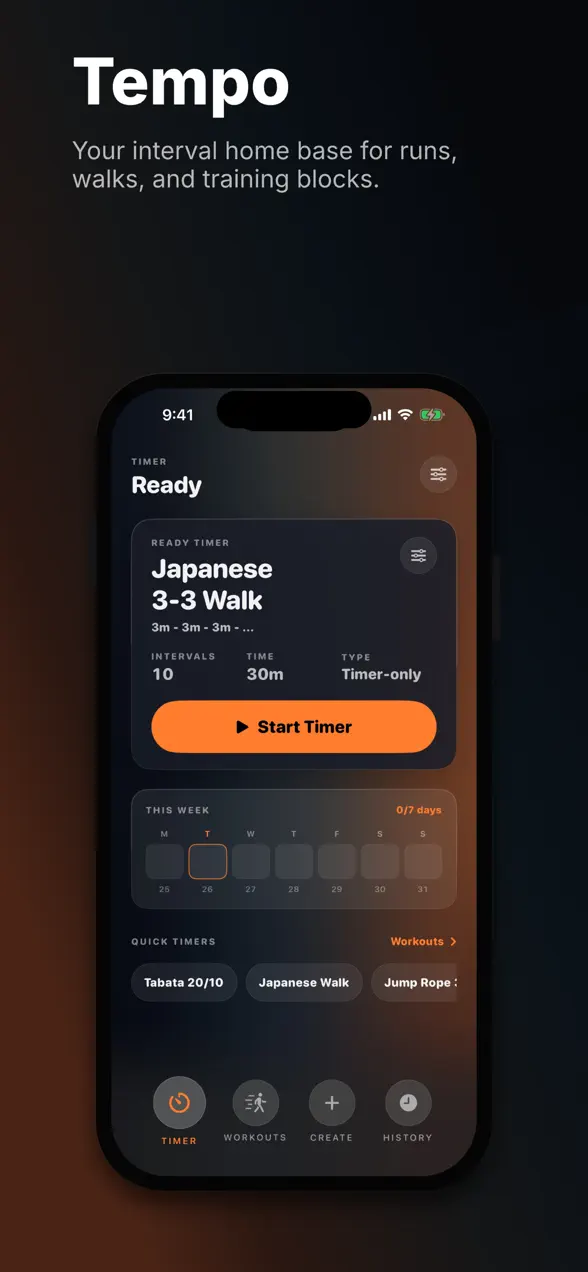
Every format above lives or dies on timing, and glancing at a clock between burpees is the worst way to keep it. I built Interval Timer: Tempo to fix exactly that, and it's what I use for these sessions.
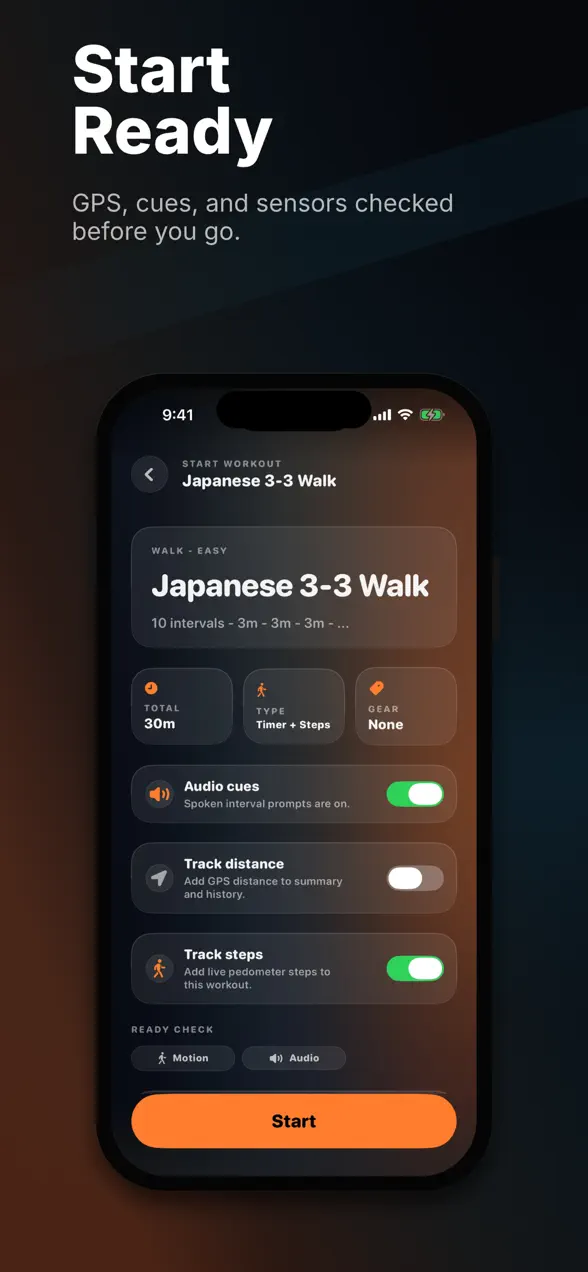
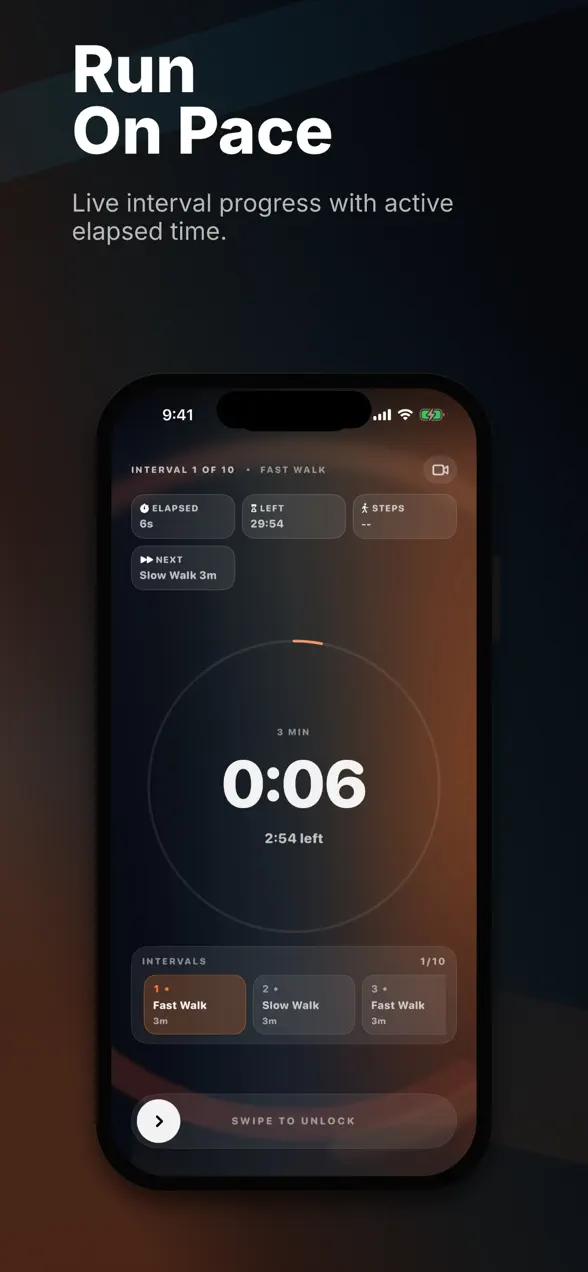
- Presets for the common formats. Tempo ships with HIIT, Tabata, running, walking, jump rope, abs, boxing, hiking, mobility and a Japanese interval walking preset (3 minutes fast, 3 minutes easy, 30 minutes).
- Custom builds for the rest. Work, rest, warm-up and cool-down intervals with labels and repeat groups cover a 7-minute circuit or an EMOM. Intervals can run by time, GPS distance or steps.
- Cues you don't have to look at. Audio and haptic cues and countdowns mark every change without stopping your music.
Pricing, plainly: Tempo is free with an ad before a workout starts, and the free tier limits how many custom workouts you can save. Tempo Premium is $0.99 a week or $5.99 lifetime and removes the ads, unlocks unlimited custom workouts, video mode and live heart rate, calories and steps. It needs iOS 26 and runs on iPhone and iPad. The full Tempo review goes deeper, and Tempo vs Seconds compares it with the best-known alternative.
The mindset that makes it stick
The real win of short workouts isn't the 4 minutes of Tabata. It's that a 4-minute session is hard to talk yourself out of. Consistency comes from sessions small enough to start on a busy Tuesday; results come from going genuinely hard while the clock runs. If strength is your goal, pair these with a simple lifting log; I wrote about why lifting progress stalls in why you're not seeing gym gains. Pick one format, copy one session, and set it up tonight.
Frequently asked questions
Can a short workout actually make a difference?
Yes, if it is hard enough. In a 12-week trial, sedentary men who did three 10-minute sessions a week, with just 1 minute of all-out effort in each, improved their peak oxygen uptake by 19%, the same as a group doing 50-minute moderate sessions. WHO guidelines also count vigorous minutes roughly double, so 75 to 150 vigorous minutes a week meets the same target as 150 to 300 moderate minutes.
What is a Tabata workout?
Tabata is 20 seconds of very hard work followed by 10 seconds of rest, repeated 7 to 8 times, about 4 minutes in total. It comes from a 1996 study by Izumi Tabata and colleagues in which subjects pedaled at about 170% of their VO2 max on a cycle ergometer, 5 days a week for 6 weeks. Their VO2 max rose by 7 ml/kg/min and anaerobic capacity by 28%. Most bodyweight Tabata sessions are gentler versions of that protocol.
What does EMOM mean?
EMOM stands for Every Minute On the Minute. At the start of each minute you do a set number of reps, then rest for whatever time is left in that minute. Finish faster and you earn more rest, which makes it self-pacing and easy to scale.
Is the 7-minute workout enough on its own?
One round is a good start, not a full program. The 2013 ACSM's Health & Fitness Journal article that described it suggests repeating the 7-minute circuit 2 to 3 times as you get fitter. It also includes wall sits and planks, which the American Medical Society for Sports Medicine says are not recommended for people with high blood pressure or heart disease.
Sources
- Gillen JB, Martin BJ, MacInnis MJ, Skelly LE, Tarnopolsky MA, Gibala MJ. Twelve weeks of sprint interval training improves indices of cardiometabolic health similar to traditional endurance training despite a five-fold lower exercise volume and time commitment. PLOS ONE. 2016;11(4):e0154075. doi:10.1371/journal.pone.0154075
- Bull FC, Al-Ansari SS, Biddle S, et al. World Health Organization 2020 guidelines on physical activity and sedentary behaviour. British Journal of Sports Medicine. 2020;54(24):1451-1462. doi:10.1136/bjsports-2020-102955
- Tabata I, Nishimura K, Kouzaki M, et al. Effects of moderate-intensity endurance and high-intensity intermittent training on anaerobic capacity and VO2max. Medicine and Science in Sports and Exercise. 1996;28(10):1327-1330. doi:10.1097/00005768-199610000-00018
- Klika B, Jordan C. High-intensity circuit training using body weight: maximum results with minimal investment. ACSM's Health & Fitness Journal. 2013;17(3):8-13. doi:10.1249/FIT.0b013e31828cb1e8
- American Medical Society for Sports Medicine. Coach's Corner: The 7-Minute Workout. amssm.org. Accessed September 2026.
- Nemoto K, Gen-no H, Masuki S, Okazaki K, Nose H. Effects of high-intensity interval walking training on physical fitness and blood pressure in middle-aged and older people. Mayo Clinic Proceedings. 2007;82(7):803-811. doi:10.4065/82.7.803
First published . Updated September 26, 2026: added the research behind each format with links, corrected the Tabata and 7-minute workout details, merged two duplicate Tempo sections and stated Tempo's pricing precisely.