
If you want to get fitter, do Japanese interval walking. If you want to move more across the day, count steps. The best answer is both. In the original 5-month trial, people who alternated 3 minutes of fast walking with 3 minutes of easy walking gained 13 to 17% in thigh strength and 8 to 9% in peak aerobic capacity, significantly more than a group told to walk 8,000 or more steps a day at a moderate pace. But daily step totals are what the big longevity studies track, so your step count still earns its place.
The verdict at a glance
Japanese walking wins on fitness per minute; a step goal wins on everyday movement. Here's how they compare:
| Japanese interval walking | 10,000 steps (or any step goal) | |
|---|---|---|
| What it trains | Intensity: heart, lungs and leg strength | Volume: total movement across the day |
| Time | About 30 minutes, 4+ days a week | Spread across the whole day |
| Best evidence for | Aerobic capacity, thigh strength, blood pressure (randomized trials) | Lower risk of early death and chronic disease (large cohort studies) |
| Equipment | A timer | A phone or step counter |
| Choose it if | You want measurable fitness gains, fast | You sit a lot and want to move more overall |
What is Japanese interval walking?
It's a walking workout developed by Hiroshi Nose, Shizue Masuki and colleagues at Shinshu University in Matsumoto, Japan, called Interval Walking Training in the research. The protocol they tested is simple:
- 3 minutes fast at 70% or more of your peak walking capacity. In practice, "somewhat hard": you can speak in short phrases, not full sentences.
- 3 minutes slow at about 40%, an easy stroll that lets you recover.
- 5 or more rounds, so about 30 minutes in total.
- 4 or more days a week.
What did the research actually find?
Interval walking beat steady step-counting on fitness in a head-to-head trial. In Nemoto et al. (Mayo Clinic Proceedings, 2007), 246 adults with an average age of 63 were randomly split into three groups for 5 months: no training, moderate continuous walking (told to take 8,000 or more steps a day at about 50% of capacity, checked with a pedometer), or interval walking. The interval group improved on every fitness measure, and every gain was significantly bigger than in the steady-walking group. Their resting systolic blood pressure also fell more.
Interval walking group: gains after 5 months
Source: Nemoto et al., Mayo Clinic Proceedings, 2007. Isometric thigh strength and peak aerobic capacity (VO2 peak). All four gains were significantly larger than those in the group walking 8,000+ steps a day at a moderate pace.
Later work from the same team adds two useful details:
- The fast minutes do the work. In a 5-month program with 679 people (Masuki et al., 2019), estimated aerobic capacity rose 14% on average. Gains grew with fast-walking time up to about 50 minutes a week, then leveled off. Slow walking time and total walking time didn't predict improvement at all.
- The least fit gain the most. In 666 people analyzed after 4 months (Morikawa et al., 2011), everyone improved, but the biggest changes in fitness, blood pressure and blood sugar came in the group that started with the lowest fitness.
Two honest caveats. First, sticking with it is the hard part: in the 2007 trial only about half of the interval group met the full targets, although a longer program averaged 70% adherence over 22 months (Masuki et al., 2015). Second, most of this research comes from one team studying middle-aged and older adults in Japan. The results are consistent, but they aren't yet a huge international evidence base.
Where 10,000 steps still wins
Step counts win on the outcome that matters most: living longer. The 10,000 figure itself came from a 1965 Japanese pedometer rather than a study; I cover that history and the evidence in detail in is 10,000 steps a day a myth?
What the big studies show is that total daily steps track closely with lower risk of early death. Pooling 15 cohorts and 47,471 adults, Paluch et al. (2022) found risk kept falling up to about 6,000 to 8,000 steps a day for people 60 and older and 8,000 to 10,000 for younger adults. And in Saint-Maurice et al. (JAMA, 2020), once total steps were accounted for, walking pace wasn't linked with mortality. In other words, for longevity, volume is what gets measured and what matters. For fitness, intensity is.
How to combine them
Keep a daily step goal, and turn a few of your walks into interval sessions. The session counts toward your steps, so you get both. A simple week looks like this:
- 3 to 4 days: one 30-minute Japanese walking session (5 rounds of 3 fast, 3 slow). That's 15 fast minutes each time, or 45 to 60 a week, right where the 2019 data leveled off.
- Every day: an everyday step goal near your baseline plus 1,000 to 2,000, working toward 7,000 to 8,000.
- If 30 minutes is too much: start with 3 rounds, or 2 minutes fast and 3 slow, and build up. My 12-week walking plan for VO2 max lays out a gradual progression.
If you're new to exercise, over 65 with health conditions, or have heart or blood pressure concerns, check with your doctor before adding hard efforts. Stop if you feel chest pain, dizziness or unusual breathlessness.
How to time Japanese walking with Tempo
The only friction is timing the switches, and checking a clock every 3 minutes wrecks the rhythm. I built Interval Timer: Tempo partly for this. It ships with a ready-made "Japanese 3-3 Walk" preset (10 intervals, 30 minutes) and calls out each switch with spoken cues and haptics, without stopping your music.

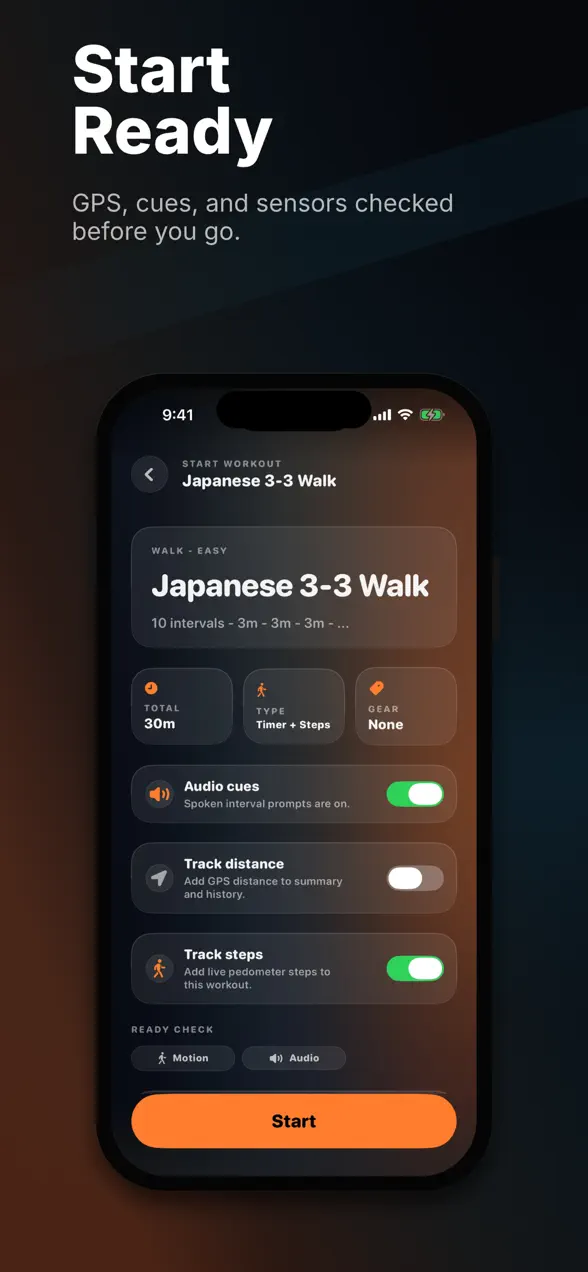
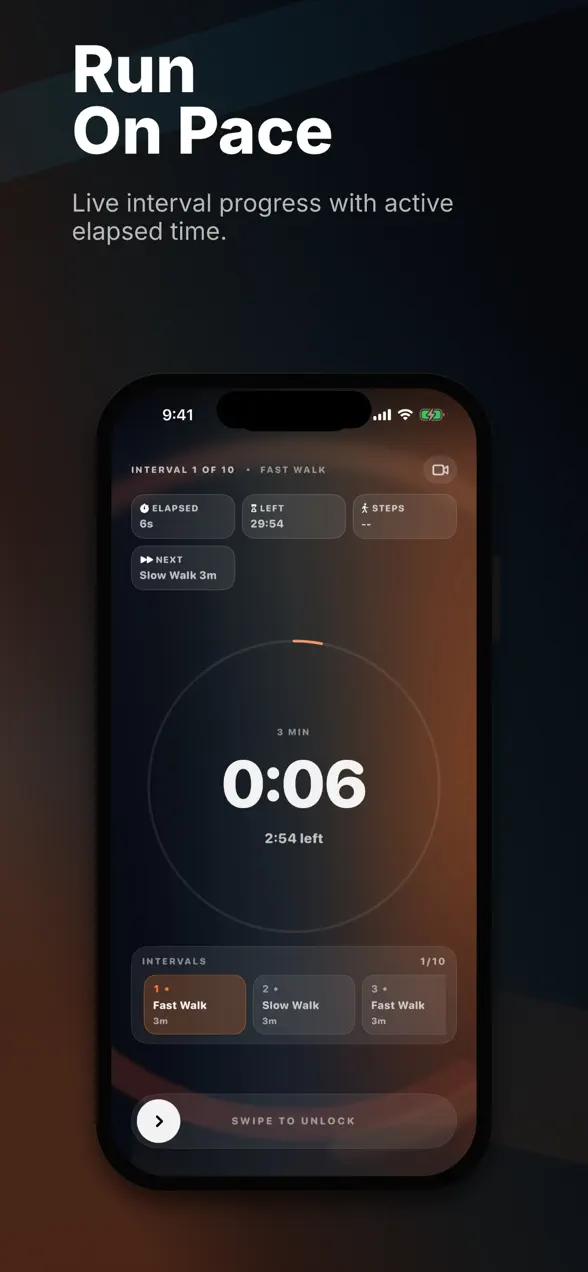
- Open Tempo and pick the Japanese 3-3 Walk preset (or build your own with a warm-up and cool-down).
- Check that audio cues are on, then put your phone away.
- Walk fast when it says fast, easy when it says easy. That's it.
Tempo is free with an ad before a workout starts. Tempo Premium ($0.99 a week or $5.99 lifetime) removes those ads and adds unlimited custom workouts, video mode and live heart rate, calories and steps. It needs iOS 26 and runs on iPhone and iPad. More detail is in the Tempo review and my honest Tempo vs Seconds comparison.
Frequently asked questions
Is Japanese walking better than 10,000 steps?
For building fitness, yes. In a 5-month randomized trial of 246 adults with an average age of 63, interval walking raised thigh strength by 13 to 17% and peak aerobic capacity by 8 to 9%, significantly more than walking 8,000 or more steps a day at a moderate pace. For general health and longevity, total daily steps still matter, so the best plan uses both.
How fast should the fast part of Japanese walking be?
In the studies, the fast minutes were at 70% or more of each person's peak walking capacity, which most people describe as somewhat hard. You should be breathing hard enough that you can only speak in short phrases. The slow minutes were at about 40%, an easy stroll that lets you recover.
Does a Japanese walking session count toward my daily steps?
Yes. Every step of the fast and slow minutes counts, so a 30-minute interval walk adds to your daily total. That is why the two approaches combine so easily: the session builds fitness and the steps count toward your volume goal.
How long does Japanese walking take to show results?
The main studies measured changes after 4 to 5 months of training on 4 or more days a week. In a 679-person program, gains in estimated aerobic capacity grew with fast-walking time up to about 50 minutes a week. Give it at least a few months of regular sessions before judging.
Sources
- Nemoto K, Gen-no H, Masuki S, Okazaki K, Nose H. Effects of high-intensity interval walking training on physical fitness and blood pressure in middle-aged and older people. Mayo Clinic Proceedings. 2007;82(7):803-811. doi:10.4065/82.7.803
- Masuki S, Morikawa M, Nose H. High-intensity walking time is a key determinant to increase physical fitness and improve health outcomes after interval walking training in middle-aged and older people. Mayo Clinic Proceedings. 2019;94(12):2415-2426. doi:10.1016/j.mayocp.2019.04.039
- Morikawa M, Okazaki K, Masuki S, et al. Physical fitness and indices of lifestyle-related diseases before and after interval walking training in middle-aged and older males and females. British Journal of Sports Medicine. 2011;45(3):216-224. doi:10.1136/bjsm.2009.064816
- Masuki S, Mori M, Tabara Y, et al. The factors affecting adherence to a long-term interval walking training program in middle-aged and older people. Journal of Applied Physiology. 2015;118(5):595-603. doi:10.1152/japplphysiol.00819.2014
- Paluch AE, Bajpai S, Bassett DR, et al. Daily steps and all-cause mortality: a meta-analysis of 15 international cohorts. The Lancet Public Health. 2022;7(3):e219-e228. doi:10.1016/S2468-2667(21)00302-9
- Saint-Maurice PF, Troiano RP, Bassett DR Jr, et al. Association of daily step count and step intensity with mortality among US adults. JAMA. 2020;323(12):1151-1160. doi:10.1001/jama.2020.1382
First published . Updated September 26, 2026: moved the verdict to the top, added the trial results with links (replacing an illustrative chart with published numbers), shortened the 10,000-steps history and corrected the Tempo pricing details.