
Short answer: partly. The 10,000 steps goal came from a 1965 Japanese pedometer, not from a study. The best recent evidence says most of the benefit arrives sooner. In a 2022 analysis of 15 studies and 47,471 adults, the drop in risk of early death leveled off at about 6,000 to 8,000 steps a day for people 60 and older, and 8,000 to 10,000 for younger adults. A 2025 review of 57 studies called 7,000 a day a realistic target. So 10,000 isn't wrong. It just isn't the minimum.
Where did 10,000 steps even come from?
It came from Japan, a few years after the 1964 Tokyo Olympics. According to Yamasa's own company history (in Japanese), in 1963 the founder, Jiro Kato, was asked to build a step counter to support a "walk 10,000 steps a day" campaign that doctors and journalists were promoting. The reasoning was arithmetic, not a trial: 10,000 steps at a 70 cm stride is about 7 km, which was roughly the least they wanted people to walk each day.
Yamasa launched the device in 1965 as the "Manpo Meter." Manpo means "10,000 steps," and the needle went round the dial once every 10,000 steps. It was a mechanical gadget that cost ¥2,200, at a time when a university graduate's first monthly salary was ¥20,000 to ¥30,000. The company registered the name Manpo-kei (万歩計, "10,000-step meter") as a trademark in 1984, and by then the number had picked up a second selling point: 10,000 steps burns roughly 300 kcal.
Researchers agree on the gist. When I-Min Lee and colleagues at Harvard published their 2019 step study, they wrote that the goal "has limited scientific basis" and likely derives from the trade name of that 1965 pedometer. So it wasn't a pure ad slogan, but it was a round public-health number chosen decades before anyone measured steps against health outcomes.
What does the research actually say about daily steps?
More daily steps are linked with a lower risk of early death, and the curve flattens well before 10,000 for many people. Four studies carry most of the weight:
- Older women, 2019. Lee et al. (JAMA Internal Medicine) tracked 16,741 women with an average age of 72. Those taking about 4,400 steps a day had a 41% lower risk of death over about 4 years than those taking about 2,700. The benefit kept growing up to roughly 7,500 steps, then leveled off.
- US adults 40 and over, 2020. Saint-Maurice et al. (JAMA) followed 4,840 adults for about 10 years. Compared with 4,000 steps a day, 8,000 was linked with a 51% lower risk of death, and 12,000 with a 65% lower risk. In this group, more kept helping past 8,000.
- 15 studies pooled, 2022. Paluch et al. (The Lancet Public Health) combined 47,471 adults. Risk fell steadily until about 6,000 to 8,000 steps for adults 60 and older, and 8,000 to 10,000 for adults under 60, then flattened.
- 57 studies reviewed, 2025. Ding et al. (The Lancet Public Health) looked beyond death rates. Compared with 2,000 steps a day, 7,000 was linked with a 47% lower risk of death, 25% lower risk of cardiovascular disease, 38% lower risk of dementia, 22% fewer depressive symptoms and 14% lower risk of type 2 diabetes.
Risk of death by daily steps, least active group = 100
Source: Paluch et al., The Lancet Public Health, 2022. Adjusted hazard ratios for each quarter of 47,471 adults, labeled by that group's median daily steps. The biggest drop comes from leaving the least active group. Observational data: it shows an association, not proof that steps alone caused the difference.
One honest caveat. All of these are observational studies. People who walk more may also be healthier in ways the researchers can't fully adjust for, and the 2025 review lists that residual confounding as a limitation. Still, the pattern is consistent across countries, ages and methods, and it points the same way every time: moving from very little to a moderate amount matters most.
| The 10,000 steps myth | What the studies found |
|---|---|
| A scientific minimum everyone must hit | A round number from a 1965 pedometer; "limited scientific basis" (Lee, 2019) |
| Below 10,000 doesn't count | 7,000 steps linked with 47% lower risk of death vs 2,000 (Ding, 2025) |
| One target fits every age | Benefit leveled at 6,000 to 8,000 for 60+, 8,000 to 10,000 for under 60 (Paluch, 2022) |
| More is always dramatically better | The first few thousand extra steps bring the biggest drop in risk |
| Pace doesn't matter at all | For longevity, total steps mattered most; for fitness, pace matters (see below) |
So how many steps should you aim for?
For most adults, 7,000 to 8,000 steps a day is a strong, evidence-based target, and anything above your current level is progress. If you already walk 10,000 and enjoy it, keep going. If 10,000 feels out of reach, don't let it stop you: the steepest part of the benefit curve is at the bottom. Here's how I'd set a goal:
- Find your real baseline. Look at your average over the last two weeks in Apple Health or your step app, not your best day.
- Add about 1,000 to 2,000 steps. If you average 4,000, aim for 5,000 to 6,000, not 10,000. A 10 to 15 minute walk usually covers it.
- Judge the week, not the day. One sick day or long flight means nothing. A weekly average that drifts up does.
- Raise the bar once it feels easy, until you're around 7,000 to 8,000.
Steps are about how much you move. If you also want to get fitter, meaning a stronger heart and lungs, the pace of some of those steps matters. That's where Japanese interval walking, and how it compares with a step goal, comes in, and why walking can raise your VO2 max if you add brisk efforts. If you have a heart condition or haven't been active for a while, check with your doctor before making a big jump.
How I track my own steps
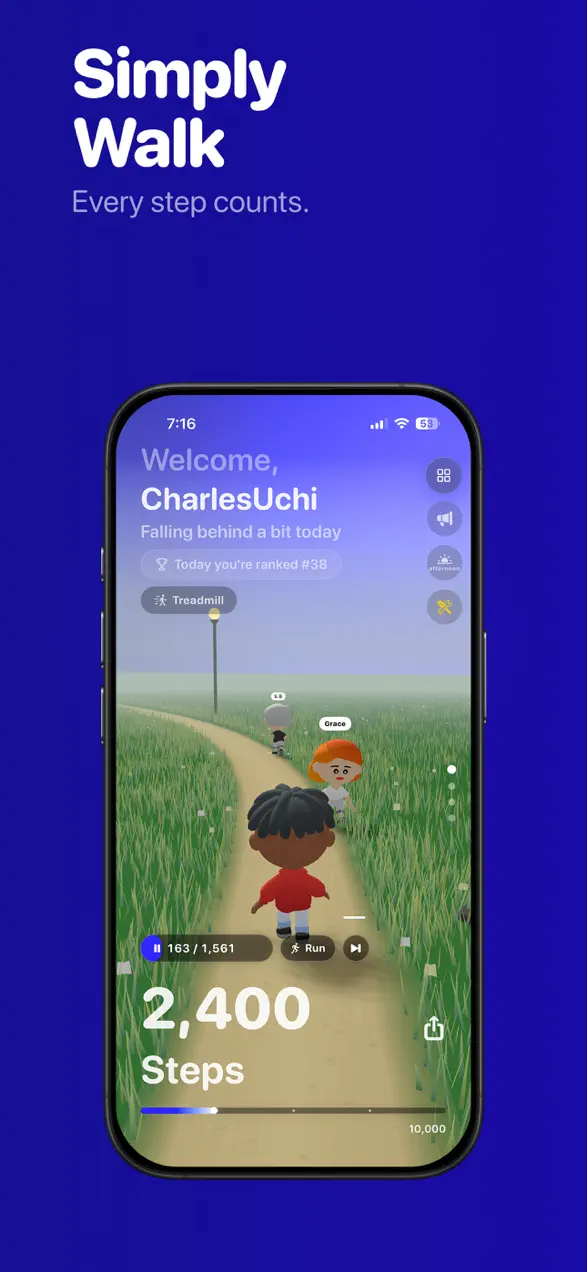
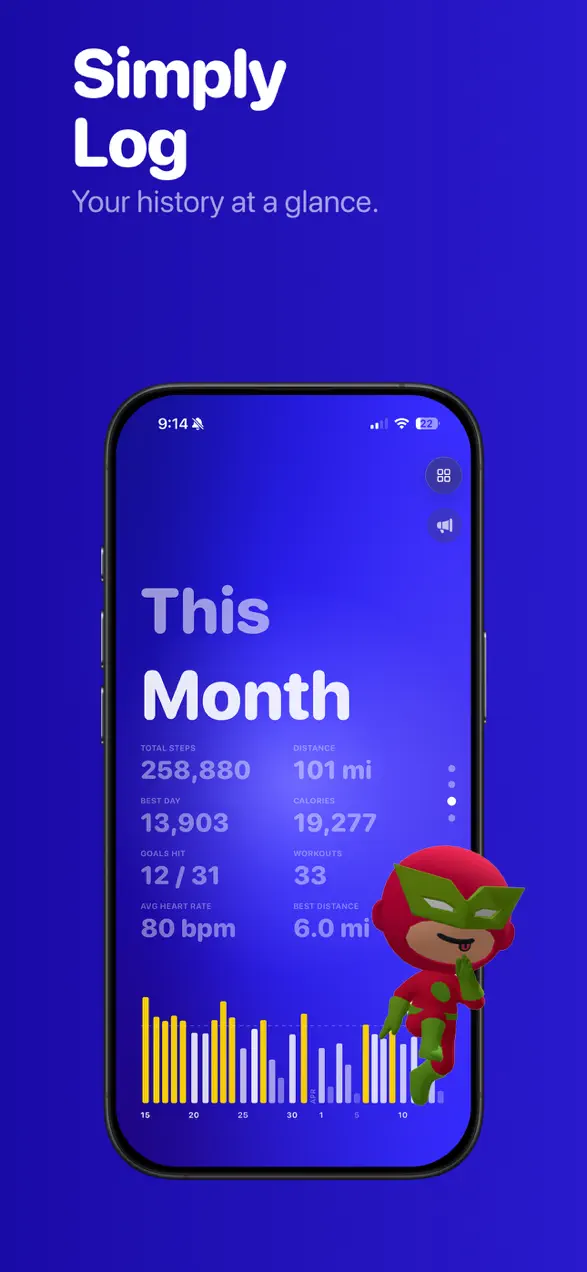
I use the app I built, Simply Step. It reads your steps from Apple Health and shows a live count plus weekly, monthly and yearly charts, so the trend is always in view. It runs on iPhone with its own Apple Watch app and widgets. It's free with ads. Simply Step Premium removes the ads and unlocks extras like Adventure mode, the full set of 21 city journeys (Venice is free) and themes. You earn coins as you walk (3 per 1,000 steps on the free tier, double with Premium) to spend on your character. The full Simply Step review covers everything else.

If you'd rather have something to walk for than a number to hit, StepPup is my other walking app: a virtual dog whose happiness follows your real steps. It's completely free with no in-app purchases. I wrote more about why that kind of nudge works in 7 ways to trick yourself into walking more.
The bottom line
- 10,000 steps is a round number from a 1965 Japanese pedometer, not a threshold found in research.
- In pooled data, the drop in risk of early death leveled off around 6,000 to 8,000 steps for older adults and 8,000 to 10,000 for younger adults.
- 7,000 steps a day is linked with large reductions in risk compared with 2,000, across several diseases.
- The biggest gain comes from leaving a very low baseline. Set a goal just above yours and nudge it up.
Frequently asked questions
Where did the 10,000 steps goal come from?
Japan in the 1960s. Yamasa, a Japanese clock and instrument maker, released a pedometer called the Manpo Meter in 1965 to support a walk-10,000-steps-a-day campaign. Manpo means 10,000 steps. The figure came from simple arithmetic (10,000 steps at a 70 cm stride is about 7 km), not from a study of health outcomes. Researchers still describe it as having limited scientific basis.
How many steps a day do I actually need?
There is no single number, but large studies point to about 7,000 to 8,000 steps a day as a strong target for most adults. A 2022 meta-analysis of 15 cohorts found the drop in mortality risk leveled off at about 6,000 to 8,000 steps for adults 60 and older and 8,000 to 10,000 for younger adults. A 2025 review linked 7,000 steps with a 47% lower risk of death compared with 2,000. If you are well below that, any increase helps.
Is walking 10,000 steps a day still worth it?
Yes, if it fits your life. Some studies, such as a 2020 JAMA study of US adults, found risk kept falling above 8,000 steps. The myth is that 10,000 is a minimum you must hit. If a big number stops you from starting, a smaller goal you meet most days is worth more.
Does walking pace matter, or only the step count?
For lower risk of early death, the big studies found total daily steps mattered most. Once total steps were accounted for, pace added little or nothing in most analyses. For building fitness, such as VO2 max and leg strength, pace does matter, which is why interval walking works well alongside a daily step goal.
Sources
- Lee I-M, Shiroma EJ, Kamada M, Bassett DR, Matthews CE, Buring JE. Association of step volume and intensity with all-cause mortality in older women. JAMA Internal Medicine. 2019;179(8):1105-1112. doi:10.1001/jamainternmed.2019.0899
- Saint-Maurice PF, Troiano RP, Bassett DR Jr, et al. Association of daily step count and step intensity with mortality among US adults. JAMA. 2020;323(12):1151-1160. doi:10.1001/jama.2020.1382
- Paluch AE, Bajpai S, Bassett DR, et al. Daily steps and all-cause mortality: a meta-analysis of 15 international cohorts. The Lancet Public Health. 2022;7(3):e219-e228. doi:10.1016/S2468-2667(21)00302-9
- Ding D, Nguyen B, Nau T, et al. Daily steps and health outcomes in adults: a systematic review and dose-response meta-analysis. The Lancet Public Health. 2025;10(8):e668-e681. doi:10.1016/S2468-2667(25)00164-1
- Yamasa Tokei Keiki. 万歩計の歩み (History of the Manpo-kei). yamasa-tokei.co.jp. Accessed September 2026.
First published . Updated September 26, 2026: added the documented origin of the 10,000 figure, real numbers from four major step studies with links, a chart built from published data (replacing an illustrative one), and a shorter, more accurate app section.