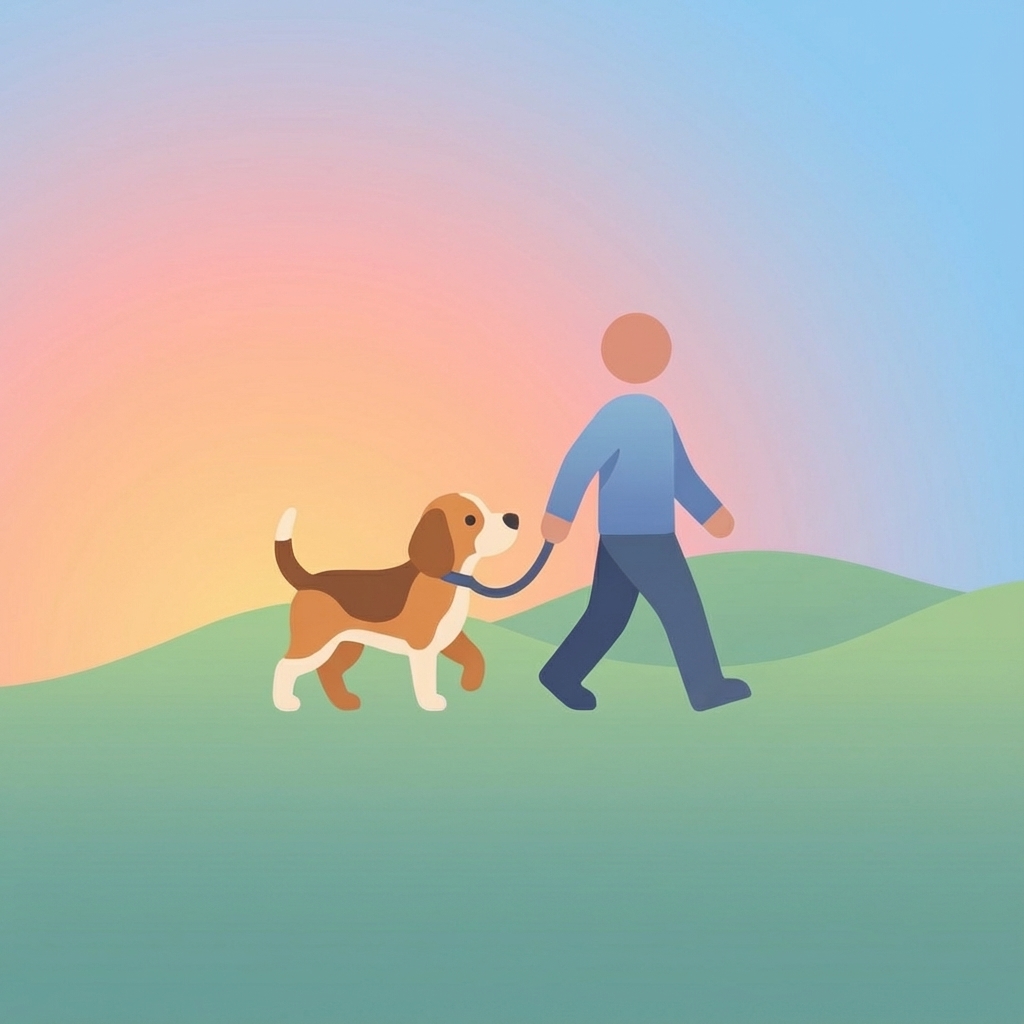
To walk more every day, stop relying on motivation and set things up so walking is the easy, rewarding default. The seven tactics below each have research behind them: tie the walk to something you already do, keep a low-bar streak, reward yourself instantly, save a favorite podcast for walks, walk a pet (real or virtual), remove friction, and let someone else see your progress. In one trial, simply saving audiobooks for the gym raised visits by 51% at first. In another, game-style points plus friendly competition added about 920 steps a day.
Why does willpower fail when you try to walk more?
Because motivation isn't steady. It moves with sleep, stress, weather and mood, so any plan that needs you to feel like walking will break on the days you don't. That part is uncontroversial.
You'll often read that willpower is a finite resource that runs out through the day ("ego depletion"). I used to say that too, but the evidence hasn't held up. In a 23-lab preregistered replication with 2,141 people, Hagger et al. (2016) found an effect close to zero. A second 36-lab test with 3,531 people, Vohs et al. (2021), also found no reliable depletion effect in its planned analyses. So the problem isn't an empty tank. It's that in-the-moment decisions are easy to lose.
What works better is taking the decision away. Habits run on a cue, an easy start, and a reward. And they take a while to form: in Lally et al. (2010), 96 volunteers building a daily health habit took a median of 66 days for it to feel automatic, with a range of 18 to 254 days. The same study found that missing one day didn't materially set people back. Each tactic below is a way to install that loop.
| Tactic | What it fixes | The evidence |
|---|---|---|
| 1. Habit stacking | Forgetting to start | If-then plans: medium-to-large effect across 94 tests |
| 2. Low-bar streaks | Quitting after one slip | One missed day didn't derail habit formation |
| 3. Instant rewards | No payoff today | Points and levels raised daily steps in a 602-person trial |
| 4. Temptation bundling | Walking feels boring | Gym visits up 51% at first when audiobooks were gym-only |
| 5. Walk a pet | Easy to let yourself off | Dog owners 4× as likely to meet activity guidelines |
| 6. Less friction | Not getting out the door | Practical: fewer decisions before you start |
| 7. Make it social | No one notices if you skip | Competition kept steps higher even after the game ended |
1. Stack the walk onto something you already do
Attach the walk to an existing routine with the formula "after I [current habit], I will [walk]." After I pour my morning coffee, I walk to the end of the block and back. After my last work call, I do a lap of the neighborhood. James Clear popularized the name "habit stacking" in Atomic Habits and credits Stanford's BJ Fogg, who calls it anchoring.
It's a version of what psychologists call an implementation intention, an if-then plan. A meta-analysis of 94 tests with over 8,000 people (Gollwitzer and Sheeran, 2006) found these plans had a medium-to-large effect on actually reaching goals. The existing habit becomes the alarm clock for the new one.
2. Keep a streak, but set the bar low
"Don't break the chain" means marking every day you walk and trying not to break the run. It's often credited to Jerry Seinfeld, though he said in a 2014 Reddit AMA that it wasn't his idea. Whoever invented it, a growing streak is motivating because losing it feels like a loss, not just a skipped task.
The rule that makes streaks survive real life: keep the daily minimum small. A streak built on 12,000 steps collapses the first busy week. A streak built on "ten minutes outside" can run for months, and on good days you'll walk far more. If you do miss a day, Lally's data says it barely matters, so start again the next morning.
3. Give every walk an immediate reward
Walking's health payoff is real but distant, so it does little to get you out the door today. A quick, visible reward does more: a number going up, a level completed, a goal ring closing.
This isn't just a hunch. In the STEP UP trial (Patel et al., JAMA Internal Medicine, 2019), 602 adults with overweight or obesity wore step trackers for 24 weeks. Those in a game with points and levels for hitting step goals walked more than the control group: about 920 extra steps a day with a competition element, 689 with a support partner and 637 with a team.
4. Bundle the walk with something you already crave
Temptation bundling means only allowing yourself a guilty pleasure while doing the thing you're avoiding. Katherine Milkman and colleagues tested it at a gym (Management Science, 2014): people who could only listen to gripping audiobooks at the gym visited 51% more often than the control group at first. The effect faded over time, especially after Thanksgiving, but 61% of participants later chose to pay for gym-only access to the audiobooks.
For walking, save your favorite podcast, audiobook or playlist for walks only. Now you're not dragging yourself out to exercise; you're going out to hear the next episode.
5. Walk a pet, real or virtual
Dog owners walk more, and not because they're more disciplined. In a UK community study (Westgarth et al., Scientific Reports, 2019), dog owners had four times the odds of meeting the 150-minutes-a-week activity guideline and were far more likely to walk for recreation. It's hard to talk yourself out of a walk when someone is waiting by the door.
You don't need a real dog to borrow some of that pull, though I should be honest: no study has tested virtual pets specifically. A virtual companion that visibly responds to your steps combines the accountability of a pet with the instant rewards from tactic 3. That's the idea behind StepPup, which I cover below.
6. Lower the friction until starting is trivial
Most missed walks die in the first minute, before you've left the house. Remove the obstacles in advance: shoes by the door, a default route you don't have to plan, a podcast already queued. Then give yourself a tiny on-ramp: you only have to walk for five minutes. Once you're outside, you'll usually keep going, because the hard part was starting.
7. Make your progress visible to someone else
When a friend, a group or a leaderboard can see whether you showed up, you get accountability that doesn't depend on your mood. In the STEP UP trial, the competition group was the only one still walking significantly more than the control group in the 12 weeks after the game ended. A standing walking date with a friend works too; skipping now means letting someone down.
How StepPup puts these tactics into one daily loop
I built StepPup to combine several of these tactics in one place. You adopt a virtual dog, and its happiness follows your real steps from Apple Health. Walk, and your dog gets happier, earns XP and your bond level grows. That covers the pet accountability (5) and the instant reward (3).
- Streaks and small goals (2): daily challenges, weekly community challenges and 50+ achievements keep new short-term wins coming.
- Visibility (7): add friends with a friend code and compare on a friends leaderboard, plus Game Center leaderboards.
- Something to chase: 9 breeds (Beagle, Golden Retriever, Husky, Shiba Inu, Frenchie, Great Dane, Corgi, Dalmatian and German Shepherd), cosmetics, and an AR photo mode where you can pet your dog with hand gestures.
StepPup is completely free, with no in-app purchases or subscriptions. It runs on iPhone and Apple Watch and has a widget. The full StepPup review has more, and StepPup vs Walkr compares it with Walkr if you prefer a space theme. If you'd rather just track the numbers, Simply Step is my straightforward step counter.


The honest bottom line
You won't walk more because you finally found the willpower. You'll walk more when walking becomes the easy, obvious, rewarding thing to do. Stack it onto a habit you already have, keep the daily bar low, give yourself an instant payoff, save a podcast you love for walks, and let something (a friend, a streak, a furry companion) hold you gently accountable. Pick two tactics and start this week. And if you're wondering how many steps are worth aiming for, I went through the research in is 10,000 steps a day a myth?
Frequently asked questions
Why does willpower fail when I try to walk more?
Motivation rises and falls with stress, sleep and mood, so a plan that depends on feeling motivated breaks on bad days. The popular idea that willpower is a fuel tank that runs out has not held up well: two large preregistered replications with 2,141 and 3,531 participants found little or no depletion effect. What does work is making walking the default through cues, low friction, quick rewards and accountability.
What is habit stacking and how does it help me walk more?
Habit stacking means attaching a new habit to one you already do, using the formula: after I do X, I will do Y. For example, after I pour my morning coffee, I will walk for ten minutes. It is a form of implementation intention, and a meta-analysis of 94 tests found these if-then plans had a medium-to-large effect on reaching goals.
How long does it take to make walking a habit?
Longer than 21 days for most people. In a 2010 study of 96 volunteers building a daily health habit, it took a median of 66 days for the behavior to feel automatic, with a range of 18 to 254 days. Missing a single day did not meaningfully set people back, so one slip is not a reason to quit.
Can a virtual dog really make me walk more?
It can help, but no study has tested virtual dogs specifically. What we know is that real dog owners were four times as likely to meet activity guidelines in one UK study, and that game-style points and friendly competition raised daily steps in a 602-person trial. A virtual pet like StepPup borrows those mechanics: something that visibly depends on your steps, instant rewards, and friends to compare with.
Sources
- Hagger MS, Chatzisarantis NLD, Alberts H, et al. A multilab preregistered replication of the ego-depletion effect. Perspectives on Psychological Science. 2016;11(4):546-573. doi:10.1177/1745691616652873
- Vohs KD, Schmeichel BJ, Lohmann S, et al. A multisite preregistered paradigmatic test of the ego-depletion effect. Psychological Science. 2021;32(10):1566-1581. doi:10.1177/0956797621989733
- Lally P, van Jaarsveld CHM, Potts HWW, Wardle J. How are habits formed: modelling habit formation in the real world. European Journal of Social Psychology. 2010;40(6):998-1009. doi:10.1002/ejsp.674
- Gollwitzer PM, Sheeran P. Implementation intentions and goal achievement: a meta-analysis of effects and processes. Advances in Experimental Social Psychology. 2006;38:69-119. doi:10.1016/S0065-2601(06)38002-1
- Clear J. How to build new habits by taking advantage of old ones (habit stacking). jamesclear.com. Accessed September 2026.
- Jerry Seinfeld Reddit AMA, January 6, 2014 (archived transcript). amatranscripts.com. Accessed September 2026.
- Patel MS, Small DS, Harrison JD, et al. Effectiveness of behaviorally designed gamification interventions with social incentives for increasing physical activity among overweight and obese adults across the United States: the STEP UP randomized clinical trial. JAMA Internal Medicine. 2019;179(12):1624-1632. doi:10.1001/jamainternmed.2019.3505
- Milkman KL, Minson JA, Volpp KGM. Holding the Hunger Games hostage at the gym: an evaluation of temptation bundling. Management Science. 2014;60(2):283-299. doi:10.1287/mnsc.2013.1784
- Westgarth C, Christley RM, Jewell C, German AJ, Boddy LM, Christian HE. Dog owners are more likely to meet physical activity guidelines than people without a dog: an investigation of the association between dog ownership and physical activity levels in a UK community. Scientific Reports. 2019;9:5704. doi:10.1038/s41598-019-41254-6
First published . Updated September 26, 2026: corrected the "willpower runs out" claim to reflect failed replications, added the studies behind each tactic with links, and merged two overlapping StepPup sections.