If you train hard but nothing changes, the most likely reason isn't your program. It's that your training isn't getting harder over time, and without a log you can't tell. The fix is progressive overload you can see: the American College of Sports Medicine recommends adding 2 to 10% to the load once you can beat your target by one or two reps. Add enough weekly sets, keep them genuinely hard, and write them down. That loop restarts progress for most people.
Why am I not seeing gains even though I train hard?
Because effort isn't the same as progression. Muscles adapt to the demands you place on them; once they've adapted, the same demand stops being a reason to change. If the weight, reps and hard sets in your notes (or your memory) look the same as last month, your body has little new signal to grow.
Effort feels like progress, but feelings are unreliable. Two exhausting sessions can leave you exactly where you started if the numbers never move. The good news: the fixes below are simple and free, and most of them come down to paying attention.
What is progressive overload, and why does it matter most?
Progressive overload means gradually increasing what you ask of your muscles so they keep adapting. The ACSM position stand on progression in resistance training puts it concretely: when you can do one or two reps more than your target at a given weight, raise the load by 2 to 10%. For building muscle, it recommends mostly working in the 6 to 12 rep range with 1 to 2 minutes of rest, and says higher-volume, multiple-set programs are best for maximizing growth.
You can progress with more weight, more reps at the same weight, more hard sets, or better control through a full range of motion. The lever matters less than the direction: up, over weeks. And to beat last time, you have to know what last time was.
The real reasons your gains stalled
Plateaus usually trace back to a short list of fixable mistakes:
| The mistake | The fix |
|---|---|
| Not tracking your lifts | Log every working set so you can beat last time |
| No progressive overload | Add 2 to 10% load once you beat your rep target by 1 to 2 reps |
| Too little volume, or easy "junk" sets | Build toward about 10+ hard weekly sets per muscle |
| Inconsistent effort | Log RPE or reps in reserve; finish most sets 0 to 3 reps short of failure |
| Ego lifting | Lower the load, own the full range, then build back up |
| Never easing off when run down | Take a lighter week when logged numbers stall and you feel beaten up |
1. You're not tracking your lifts
This is the root of almost everything else. Without a record you're guessing every session. You can't confirm you added weight, you can't spot a lift that's been flat for a month, and you can't tell a plateau from a bad day. Memory is a terrible spreadsheet.
2. You never apply progressive overload
Once you're tracking, the rule is simple. Pick a rep target (say 8 to 10). When you can do 11 or 12 with good form, raise the weight by the smallest jump available, which on most lifts lands in ACSM's 2 to 10% range. Then work back up the rep range. Small jumps compound into a very different body over a year.
3. Too little volume, or too many easy sets
More hard sets usually means more growth, up to a point. In a meta-analysis of 15 studies, Schoenfeld, Ogborn and Krieger (2017) found a graded dose-response: each extra weekly set per muscle was linked with a slightly bigger gain in muscle size, and programs with 10 or more weekly sets per muscle tended to do best (that comparison fell just short of statistical significance). A larger 2025 analysis of 67 studies by Pelland and colleagues found the same upward trend with diminishing returns, which were steeper for strength than for size.
But sets only count if they're hard. What lifters call "junk volume" is sets that stop far short of challenging. A 2024 meta-regression (Robinson et al.) found muscle growth improved as sets ended closer to failure, while strength gains were similar across a wide range. So before adding sets, make the ones you already do count.
4. Your effort is all over the place
One week you grind to failure, the next you cruise. A simple fix is rating each working set by reps in reserve (RIR), how many more reps you could have done. The RIR-based RPE scale developed by Zourdos et al. (2016) maps them together: RPE 10 means zero reps left, RPE 9 means one, RPE 8 means two. Helms and colleagues describe how to use it to adjust load set by set. For most working sets, aiming for RPE 7 to 10 (0 to 3 reps in reserve) keeps them honestly hard.
5. You're ego lifting
Loading the bar past what you can control feels good and builds less than you'd think. Half reps with sloppy form trade tension on the target muscle for a number to brag about. Drop the weight, use the full range with a controlled tempo, and rebuild. Your logged numbers become honest, and so do your results.
6. You never ease off when you're run down
Fatigue accumulates, and sometimes a lighter week helps. But the evidence doesn't support deloading on a strict schedule for its own sake. In a 2024 randomized trial (Coleman et al., PeerJ), trained lifters who took a full week off in the middle of a 9-week program grew just as much muscle as those who kept training, but gained slightly less lower-body strength. My takeaway: ease off when your log shows two or three weeks of stalled or falling numbers and you feel beaten up, not because the calendar says so.
How do you actually fix it?
You don't need a new program. You need a feedback loop:
- Write down every working set: weight, reps and how hard it felt (RPE or RIR).
- Before each set, look at what you did last time.
- Beat it by a rep or a small jump in weight when you can.
- Keep most sets within 0 to 3 reps of failure, and build toward about 10 hard sets per muscle per week.
- Back off for a week only when the log and your body both say so.
That loop is most of the game, and it's why a good log matters more than a clever routine. If you're short on time and want conditioning too, my guide to quick workouts that actually work pairs well with it.
How Phyziq makes the loop easier
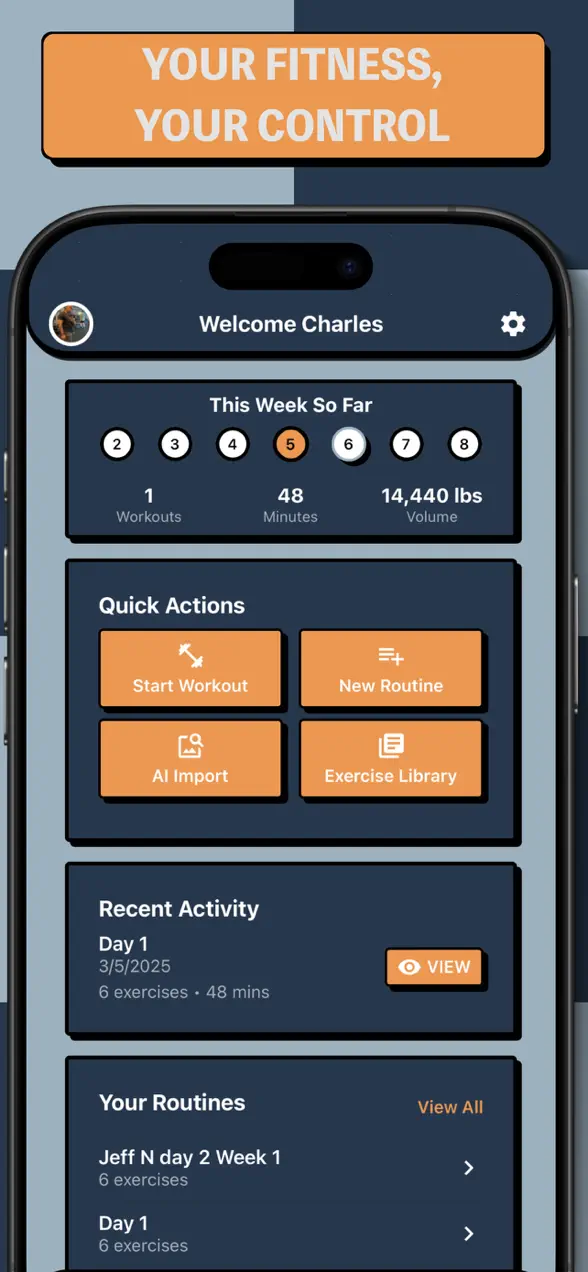
I built Phyziq because every plateau I've broken started with finally writing things down, and I wanted a log fast enough to use between sets. It's completely free, with no in-app purchases, and runs on iPhone (with a widget). There's no Apple Watch app, though it can read heart rate from your Watch, AirPods or Beats through Apple Health.
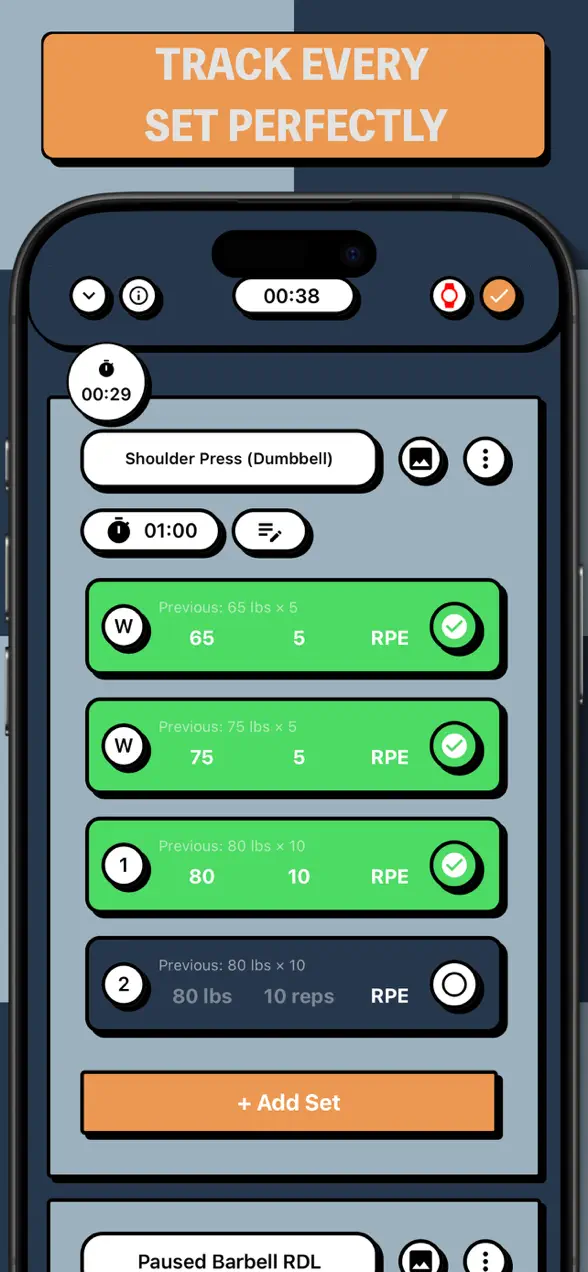
- Last time, on every set. Each set row shows what you lifted last session (for example "Previous: 80 lbs × 10"), so beating it is the obvious next move.
- Effort you can see. Log RPE and set types (warm-up, normal, drop set, failure) next to weight and reps, with a built-in rest timer.
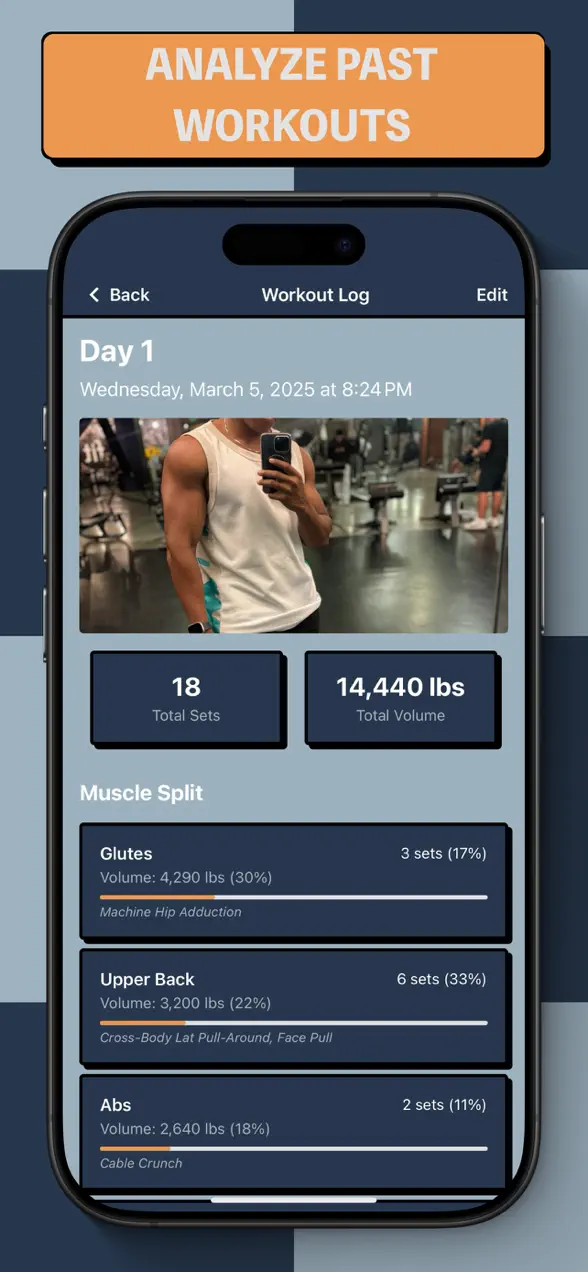
- Progress without spreadsheets. Personal records, charts, muscle heatmaps, progress photos and body measurements.
- Less setup friction. Snap a photo of a written workout plan and the AI routine import pulls out the exercises, or have the AI program generator build one. There are 340+ exercises, Apple Health import and export, and import from Hevy (not from Strong, yet).
For the full tour, read the Phyziq gym log review. If you're choosing between apps, my Phyziq vs Strong comparison lays out the trade-offs, including where Strong is ahead.
The one habit that changes everything
If you take one thing from this, start logging. Not because it's fancy, but because you can't improve a number you never wrote down. The lifters who keep growing year after year are rarely the ones with the most exotic programs. They know what they lifted last time, and they beat it.
Frequently asked questions
Why am I not seeing gains even though I train hard?
Usually because the training is not progressing. If the weight, reps and hard sets you do this month match last month, your muscles have little new reason to adapt. The American College of Sports Medicine recommends raising the load by 2 to 10% once you can do one or two reps more than your target. Logging your sets is what makes that possible.
How many sets per week do I need to build muscle?
More sets generally mean more growth, with diminishing returns. In a 2017 meta-analysis by Schoenfeld and colleagues, each extra weekly set per muscle was linked with a slightly larger gain, and 10 or more weekly sets per muscle tended to produce the most growth, though that comparison was not statistically significant. A 2025 meta-regression of 67 studies found the same upward trend with clearer diminishing returns, especially for strength.
What do RPE and RIR mean in lifting?
RIR means reps in reserve: how many more reps you could have done. The RIR-based RPE scale maps them together, so RPE 10 means no reps left, RPE 9 means one rep left, RPE 8 means two. Research suggests muscle growth improves as sets end closer to failure, while strength gains are similar across a wide range of RIR.
Do I really need a deload week?
Not on a fixed schedule. In a 2024 randomized study, taking a full week off in the middle of a 9-week program did not change muscle growth and slightly reduced lower-body strength gains. A lighter week makes sense when your logged numbers stall or drop for a couple of weeks and you feel run down, not as a ritual.
Sources
- American College of Sports Medicine. Position stand: progression models in resistance training for healthy adults. Medicine and Science in Sports and Exercise. 2009;41(3):687-708. doi:10.1249/MSS.0b013e3181915670
- Schoenfeld BJ, Ogborn D, Krieger JW. Dose-response relationship between weekly resistance training volume and increases in muscle mass: a systematic review and meta-analysis. Journal of Sports Sciences. 2017;35(11):1073-1082. doi:10.1080/02640414.2016.1210197
- Pelland JC, Remmert JF, Robinson ZP, Hinson SR, Zourdos MC. The resistance training dose response: meta-regressions exploring the effects of weekly volume and frequency on muscle hypertrophy and strength gains. Sports Medicine. 2026;56(2):481-505 (published online December 2025). doi:10.1007/s40279-025-02344-w
- Robinson ZP, Pelland JC, Remmert JF, et al. Exploring the dose-response relationship between estimated resistance training proximity to failure, strength gain, and muscle hypertrophy: a series of meta-regressions. Sports Medicine. 2024;54(9):2209-2231. doi:10.1007/s40279-024-02069-2
- Zourdos MC, Klemp A, Dolan C, et al. Novel resistance training-specific rating of perceived exertion scale measuring repetitions in reserve. Journal of Strength and Conditioning Research. 2016;30(1):267-275. doi:10.1519/JSC.0000000000001049
- Helms ER, Cronin J, Storey A, Zourdos MC. Application of the repetitions in reserve-based rating of perceived exertion scale for resistance training. Strength and Conditioning Journal. 2016;38(4):42-49. doi:10.1519/SSC.0000000000000218
- Coleman M, Burke R, Augustin F, et al. Gaining more from doing less? The effects of a one-week deload period during supervised resistance training on muscular adaptations. PeerJ. 2024;12:e16777. doi:10.7717/peerj.16777
First published . Updated September 26, 2026: added research on overload, training volume, effort and deloads with links, corrected the deload advice to match newer evidence, and merged two overlapping Phyziq sections.